


The Hong Kong Dental License Examination (HKDLE) is the authoritative threshold for practicing dentistry locally in Hong Kong, and its value is beyond doubt. However, before deciding to pursue this exam, every candidate should carefully calculate two accounts: one is the visible economic cost, and the other is the decisive account of exam preparation strategy. Today, we will objectively break these down.
Part 1 : The Irrefutable Economic Costs That Cannot Be Ignored
The examination fee for each part of the License Examination is HK$10,650. The Secretariat will notify the applicant separately to make the payment only after confirming their eligibility for the examination.
Let’s calculate several typical spending scenarios:
1. The “one-time pass” in ideal conditions
This is the most cost-effective pathway. By passing all three components (written exam, practical exam, and clinical exam), the total direct examination fee is 10,650 x 3 = 31,950 HKD. This does not yet account for any additional costs.
2. The “Retake” Scenario in Reality
According to the official structure, candidates must pass three independent sections in sequence. This means that any failure in one stage will hinder the subsequent steps.
For instance, if the written exam (Part 1) is passed in one attempt but the practical exam (Part 2) requires a retake, the total cost becomes: 10,650 (written exam) + 10,650 x 2 (two practical attempts) = 31,950 HKD. This equals the total cost of passing “in one go” but achieves only two-thirds of the progress.
3. The Hidden Costs of Overlap
In addition to the examination fees, the mandatory expenses throughout the entire process also include:
Notarization fees for documents: Transcripts, diplomas, and other documents must be authenticated by a notary, which is a necessary expense.
Cost of taking exams in Hong Kong: All sections are held in Hong Kong. This means mainland candidates must plan at least three to four trips to Hong Kong (one to two written exams and two practical clinical exams), involving transportation, accommodation, and meals, with each trip costing several thousand to tens of thousands of HKD.
Opportunity cost of time: The time invested during exam preparation, which could have been used for work or rest, represents the greatest hidden cost.
Adding these up, the total cost from preparation to obtaining the license can easily exceed HKD 50,000 or even HKD 100,000. This does not yet account for the lost professional income due to delayed practice from exam failures.
Part 2 : What is more valuable than money is opportunity and time
The economic costs can still be calculated, but the additional time window restrictions imposed by the exam rules make each attempt even more precious.
The official rule states: Candidates may retain partial qualified scores for Paper I/Paper II for 4 years, or retake other subjects within 4 examination sessions after obtaining qualified scores, whichever occurs earlier.
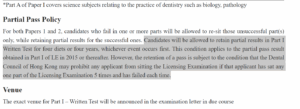
This means that from the moment you pass a subject for the first time, a countdown begins with a maximum of four years and up to four retake opportunities. While money can be earned again, once the allotted attempts are exhausted or the time limit expires, all previously passed subjects will be invalidated, and you must start over from scratch.
Therefore, inefficient and trial-and-error exam preparation not only costs more than 10,000 yuan per exam attempt but also rapidly depletes your precious and limited exam opportunities. Each failure increases the total cost of eventual success and prolongs the cycle of obtaining professional qualifications and beginning career rewards.
Part 3 : Disassembling the Core Strategies for Efficient Clearance
Faced with high costs and strict time limits, the only rational choice is to pursue the most efficient one-time pass rate. This requires exam preparation strategies to go beyond simple “reading books and practicing questions”.
Accurate benchmarking and rejection of information asymmetry: Preparation must strictly revolve around the official exam structure, question types, and recommended reference books. Information searched for by oneself with unknown sources may deviate from the focus, resulting in a huge waste of time and energy.
System planning, rejecting fragmented learning: The three parts of HKDLE are interrelated. The written test (part one) is a theoretical foundation, the practical test (part two) tests the operation, and the clinical test (part three) comprehensively evaluates the application ability. Preparing for exams must be a systematic process that is interconnected and gradually deepened, with early learning laying the groundwork for later application.
Grasp the core and transform clinical thinking: The exam aims to assess whether one possesses comprehensive qualities for safe practice in Hong Kong. Memorizing is difficult to pass clinical exams that focus on practical applications. The key lies in whether knowledge can be transformed into clinical decision-making thinking that conforms to local diagnostic and treatment standards, which is the most difficult bottleneck for self-study to overcome.
Part 4 : Investing in Certainty – CHENG HEI Education’s Solution
After clarifying the risks and difficulties, the choice becomes clear: should we allocate tens of thousands of Hong Kong dollars and several years of time as “trial and error tuition” to multiple unknown exams, or concentrate some resources on investing in a validated system solution that can maximize the first pass rate?
The HKDLE comprehensive system course of CHENG HEI Education is designed to address the core challenges mentioned above. What we offer is not a simple list of knowledge, but rather:
😉 A roadmap that is completely synchronized with the official pace: the course progress strictly benchmarks the 2026 exam date (written test: May 28th; practical and clinical: July 27-31st), ensuring that students complete key learning and sprinting at the correct time.
😉 Integrated training of “theory practice clinical”: The course runs through the detailed lectures of written examination points, practical operation methods, and clinical thinking reshaping, breaking down subject barriers and aiming to cultivate candidates’ complete ability chain to cope with the entire examination process.
😉 Facing the transformation of “Hong Kong style clinical thinking”: Led by lecturers with local practice experience, through a large number of scenario based case studies, we specialize in tackling the core pain points of mainland candidates in thinking transformation, and directly target the key to high scores in clinical exams.
Preparing for exams is a serious form of self investment. After calculating all explicit and implicit costs, smart investors will understand that the most efficient path is often the path with the lowest total cost and the fastest return.
The backend responds with ‘registration’, choosing a systematic professional preparation is not only to save current money, but also to seize valuable career time window, so that that the heavy license can be quickly transformed into the cornerstone of practical development.