
Exclusive Interview with Dr. Shuxin: Bachelor's and Master's from SYSU, PhD from HKU—How She Naturally Became a Licensed Dentist in Hong Kong
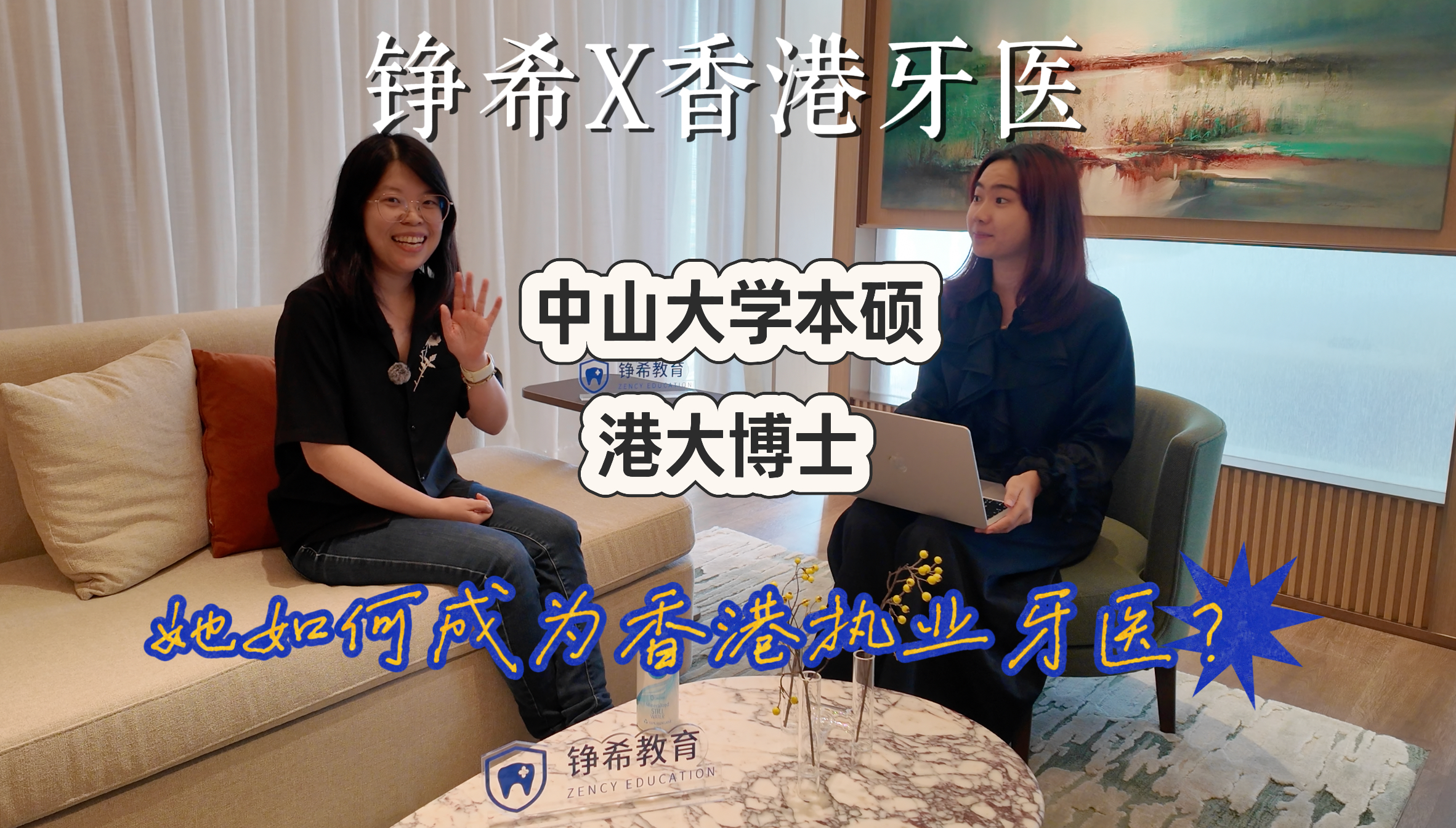
Those familiar with Zency Education will certainly recognize Dr. Shuxin. In our live and open classes, her clear logic and articulate delivery have guided candidates through many core HKDLE topics and clinical reasoning challenges.
As a scholar-practitioner with an undergraduate and master's degree from Sun Yat-sen University and a PhD from the University of Hong Kong, Dr. Shuxin is a registered, practicing general dentist who sees patients independently in Hong Kong. She has also served as Zhengxi Education's core Chinese-track instructor.
We recently sat down with Dr. Shuxin for an in-depth interview, which we have compiled into a three-part series. In this first installment, she discusses where her academic journey began, what prompted her to sit for the licensing exam while completing her PhD at HKU, and what it was really like for a mainland-trained dentist to start practicing in Hong Kong.
01 "I Simply Didn't Want to Work Back Then and Felt Like Studying More"
Looking back on her educational path and early career, Dr. Shuxin candidly admits that she never had an overly calculated master plan for her life.
She completed her consecutive bachelor's and master's degrees in stomatology at Sun Yat-sen University (SYSU), went through rigorous clinical internships and standardized residency training within the SYSU hospital system, and then practiced on the clinical frontline in Shenzhen for a brief period.
When asked why she decided to pursue a PhD at HKU, Dr. Shuxin shared an honest smile: "Back then, I simply didn't want to keep working. I thought, 'Why not continue studying?' So I applied to HKU."
Although going to Hong Kong seemed like a natural transition, Dr. Shuxin noted that her earlier clinical training at Sun Yat-sen University laid an exceptionally solid foundation for her future career in Hong Kong.
"During our fifth undergraduate year, we completed a full clinical rotation across every department. It was not a superficial internship; we were treating a substantial volume of real patients daily. The subsequent residency was just as intensive—packed from Monday to Friday, including weekend shifts—delivering a comprehensive, structured clinical training program."
Dr. Shuxin reflected that those years of high-volume, hands-on clinical experience built up her manual dexterity and diagnostic confidence. Furthermore, because Guangzhou is close to Hong Kong and aligns relatively well with Hong Kong's clinical philosophies and techniques, she did not experience a jarring disconnect when transitioning to research at HKU and preparing for the licensing examination.
02 A Decision Made in a Quarantine Hotel: Using the Exam as a Study Incentive
After starting her doctoral studies at HKU, external circumstances shifted. Beginning in 2019, followed by the pandemic, her clinical research projects—which relied heavily on recruiting patients—encountered noticeable disruption.
"During my hotel quarantine, my experiments were stalled. I figured I shouldn't waste time and needed to find something productive to do."
In Hong Kong universities, whether working as a Research Assistant (RA) or pursuing a PhD, many peers try their hand at the Hong Kong Dental Licensing Examination (HKDLE). Dr. Shuxin’s mindset was straightforward: since everyone around her was giving it a shot, she might as well use the exam as an incentive to maintain intensive study habits. If she passed, she would earn the license; if not, she would revisit her options after completing her doctorate.
Thanks to her solid foundational knowledge and focused preparation, she passed the exams during the third or fourth year of her doctoral program and formally registered as a practicing dentist in Hong Kong.
Upon obtaining her license, her doctoral supervisor happened to have a clinical research project that legally required a locally registered Hong Kong dentist to execute. Because she was already registered, her supervisor invited her to stay on after graduation to lead the project. Near the end of her doctoral studies, she transitioned from a student visa to a work visa, assisting her supervisor with the research while completing her dissertation requirements and beginning to explore part-time opportunities in local private clinics.
"After practicing in private clinics for a few months, I realized that the clinical environment and pace here suited me very well. Once my supervisor's project concluded, it was only natural for me to remain in Hong Kong as a full-time dentist."
03 Stepping into Hong Kong Clinics: Equipment Variations, Language Adaptation, and Clinical Respect
Moving from a large mainland teaching hospital to a private dental clinic in Hong Kong, what requires the most adaptation when crossing systems?
As a non-native Cantonese speaker, Dr. Shuxin noted that communication was her initial hurdle. Even for native Cantonese speakers from Guangdong, local Hong Kong colloquialisms and idiomatic expressions carry subtle differences, requiring deliberate effort to build smooth rapport with patients.
The second area involved minor differences in clinical operating habits. For instance, in the HKDLE Part 2 practical exam and routine surgical extractions, Hong Kong standardly uses British-pattern extraction forceps, whereas most mainland teaching hospitals predominantly use American-pattern forceps.
However, what impressed Dr. Shuxin most was the high level of respect local clinics extend to clinicians, along with the professionalism of the chairside support:
"Private clinics here respect a doctor's personal operating style. For example, if you explain that you are unaccustomed to British-pattern forceps and need American-pattern forceps, most clinics will order them specifically for you. Moreover, the chairside dental nurses are highly experienced and collaborative. Even if your clinical technique differs from that of other practitioners in the clinic, they will not question your approach; instead, they adapt seamlessly to support your workflow."
04 Working 50 to 60 Hours a Week, Yet Feeling Greater Freedom
When discussing her current workload in Hong Kong, Dr. Shuxin's lifestyle often earns the admiration of peers accustomed to relentless patient queues in mainland public outpatient clinics.
She currently balances two positions: full-time practice at a dental group from Monday to Friday, and part-time clinic sessions at another private practice on weekends. In total, her working hours reach roughly 50 to 60 hours per week.
Surprisingly, she feels that the mental pressure is lighter than what she experienced on the mainland:
"In mainland public outpatient clinics, patients line up one after another in an endless stream, leaving clinicians with barely enough time to catch their breath or drink water. In Hong Kong, appointment pacing is largely under the doctor's control. If you have the energy and want to earn more, you can have the nurses schedule appointments more densely; if you prefer a more relaxed pace, you can have fewer patients booked. The flexibility is substantial."
Addressing the core competitive advantage of mainland-trained dentists crossing over to Hong Kong, Dr. Shuxin gave an encouraging assessment: A robust, hands-on clinical patient volume is an irreplaceable asset for mainland doctors.
Compared to locally trained dental graduates, dentists who have undergone formal, comprehensive internships and standardized residency training on the mainland generally possess greater depth in real-world case counts and clinical crisis handling. Once candidates bridge the initial barriers of regulatory guidelines, language, and the examination framework, their practical clinical competence holds up well inside the operatory.
From overcoming information barriers to securing her registration, Dr. Shuxin's journey shows that practicing in Hong Kong is achievable through a clear understanding of the regulatory framework and turning extensive knowledge into solid clinical reflex.
As a dedicated preparation provider for the Hong Kong Dental Licensing Exam, Zency Education is committed to bridging the informational and instructional divide for dentists aspiring to practice in Hong Kong.
Our core Chinese-track curriculum is led personally by Dr. Shuxin, combining her dual perspectives from Sun Yat-sen University and HKU with frontline clinical experience in Hong Kong. Through structured live lectures and mind maps, she guides candidates step-by-step to build a knowledge structure that matches local examiner standards. Our English-track curriculum is taught by Dr. Suki Gill, a registered Hong Kong dentist with international examination experience, fully benchmarking global clinical and testing criteria.
From credential evaluation support and administrative communication assistance to authentic question simulations and one-on-one post-class guidance, Zency Education supports your preparation journey every step of the way.
In the next installment of our interview series, Dr. Shuxin will delve into the core question-setting logic across HKDLE subjects, highlight the most common cognitive blind spots for mainland candidates, and share high-scoring study methods. Stay tuned!