


For candidates planning to take part 3 of the Hong Kong Dental Licensing Examination (HKDLE), the language choice at the initial stage of preparation is a crucial decision.
Because the test language must be pre selected at the registration and application stage and cannot be changed subsequently, each candidate must objectively evaluate the test form and their own expression advantages before officially entering the review rhythm.
Part3 assessment logic of clinical examination
Part3 aims to comprehensively assess the candidates’ clinical comprehensive quality. The assessment is not limited to the depth of theoretical knowledge, but also lies in the rationality of clinical decision-making and the efficiency of professional communication. The exam usually covers the following three core areas:
- Pediatric dentistry and orthodontics: clinical judgment in related fields is assessed in the form of multiple-choice questions.
- Preservation of Dentistry, Periodontology and prosthodontics: conduct in-depth questioning for complex cases, and require candidates to clearly explain the diagnosis basis and treatment plan under pressure.
- Oral and maxillofacial surgery: To investigate the immediate response and processing ability of candidates for external emergency and conventional surgery.
⏰ Special reminder: the official has made it clear that the examinations for preserving dentistry, Periodontology and prosthetic dentistry will be conducted in the form of structured simulated viva voce. This means that there are no real patients on the test site. Candidates need to face the examiner and make oral statements in the simulated scene.
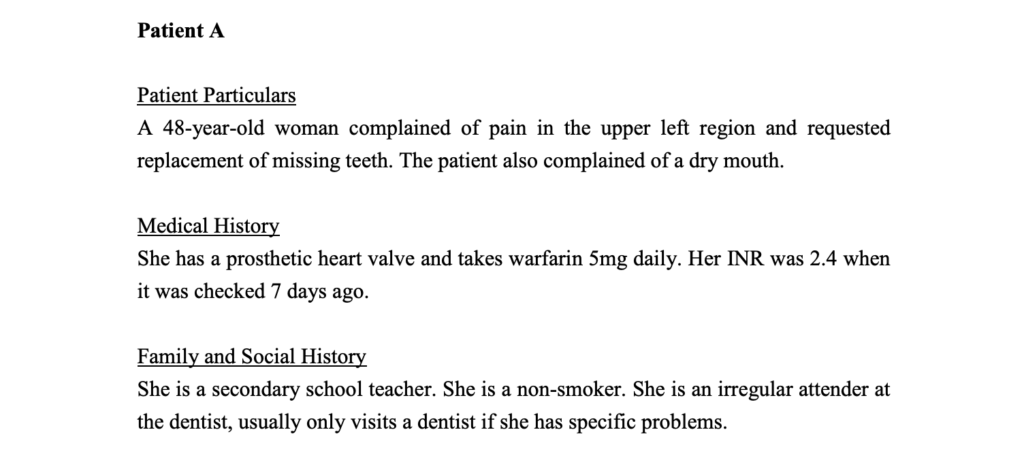
Part3 examples of clinical examination
Rigorous assessment: how to choose your test language?
Because there are a lot of impromptu questions in the oral examination, language is not only a communication tool, but also a carrier of logical expression.
It is recommended to report Cantonese:
Only candidates whose mother tongue is Cantonese or who can reach the level of local communication are recommended to choose. Examiners’ expectations for Cantonese candidates often include a good command of local medical habits and specific terms. If Cantonese is not the mother tongue, it is prone to expression bias in a high-pressure environment, which will affect the transmission of professional judgment.
It is recommended to report in English:
For most candidates with mainland backgrounds, English is usually a safer choice:
- System integration: the dental education system in Hong Kong is entirely based on English, and all professional terms, clinical guidelines and assessment standards are based on English.
- Synchronization of thinking: use English answers to accurately connect the examiner’s assessment points and reduce the loss of meaning caused by translation.
- Term advantage: compared with non-native Cantonese, dental English is the language that candidates contact more in their long-term practice, and the logical expression will be more rigorous.
Chenghei education part3 course
For clinical examinations, Chenghei education has been deeply cultivated for many years, aiming to help candidates achieve professional leaps through the most efficient path. Our course provides targeted counseling programs to meet the needs of newspaper selection in different languages:
Mandarin class (opened on May 25)
It is taught by highly qualified professional teachers. The teacher has been invited to share the experience of preparing for the test for the official part2 and part3 candidates, and has a profound understanding of the test logic. The course will focus on the in-depth disassembly of case logic to help candidates clarify the core diagnostic thinking and clinical logic in their mother tongue.
English class (open on June 2)
Focus on all English simulated combat. Through all English training in class, the candidates can adapt to the speed of change in the English environment, and ensure that they can accurately and fluently use professional terms to answer the examiner’s questions.
Part3 is the ultimate test on the road to practicing in Hong Kong. At the moment of registration, the choice has been made; But in our review stage, it is the actual combat period to turn the choice into the victory.
I wish all candidates a successful start in the clinical examination from July 29 to 31. For more course details or registration consultation, please contact us at the background.