


In today’s rapidly evolving dental industry, pursuing a broader professional platform and achieving highly recognized qualifications has become a long-term focus for many mainland dentists. With its competitive remuneration and international medical environment, the Hong Kong Dental Licensing Examination (HKDLE) has seen a steady rise in popularity. However, online information regarding this examination remains highly fragmented and inconsistent, leaving many aspiring candidates facing significant obstacles right at the starting line.
Based on recent candidate feedback, the majority of applicants find themselves stuck at three critical stages:
1. Uncertain Eligibility: Candidates are often unsure whether their degree, educational system, and clinical background fully align with the official assessment criteria.
2. Lack of Systematic Planning: Applicants frequently lack clarity regarding the assessment focuses and difficulty levels of each section, making it challenging to allocate review time effectively.
3. Misalignment of Post-Exam Procedures: Many mistakenly believe that passing the exam equates to immediate employment, resulting in a severe lack of understanding regarding the subsequent qualifications application and independent registration processes.
Many candidates spend months or even over a year conducting preliminary research, yet fail to establish a clear framework. In reality, failure or mid-way abandonment is rarely due to a lack of individual clinical competence; rather, it stems from a directional misstep during the initial phase, causing candidates to waste precious preparation cycles.
Core Pathway: Breaking Down the HKDLE Structure and Policies
The HKDLE is organized by the Dental Council of Hong Kong and serves as the sole legal pathway for non-locally trained dentists to obtain registration and practice in Hong Kong. Regardless of a candidate’s professional title or academic background, anyone who did not graduate from a local institution in Hong Kong must pass this evaluation.
1. Core Eligibility Requirements
Official policies explicitly state that applicants must have completed at least four years of full-time professional dental education. In past eligibility screenings, poorly organized documentation has been the primary reason for rejection letters. For instance, the descriptions in credit hour certificates or course syllabi often fail to precisely match the assessment logic required by the Hong Kong authorities. Since application opportunities are limited each year, any rejection due to documentation issues will directly delay the candidate’s examination timeline by an entire year.
2. Examination Structure and Key Stages
The HKDLE consists of three distinct parts, with the assessment criteria progressing hierarchically:
• Part I: Written Examination. This section evaluates basic medical and clinical dental knowledge. The exam provides bilingual test papers in both Chinese and English, meaning language is not the sole barrier. The true challenge lies in the massive volume of questions and the exceptionally broad scope of topics.
• Part II: Practical Examination. This stage involves clinical operations and laboratory tests, focusing heavily on candidates’ hands-on skills and standardized procedures. This phase enforces exceptionally rigorous standards on aseptic concepts, operational sequences, and cavity preparation precision to the micrometer level. It represents a major hurdle that candidates must systematically overcome.
• Part III: Clinical Case Analysis. This section focuses on evaluating candidates’ clinical reasoning, medical ethics, and their capacity for case analysis and professional communication within the framework of Hong Kong’s healthcare system. It demands a mature, comprehensive clinical perspective from the candidate.
3. Qualifications, Registration, and the Practice Procedure
Passing all three parts of the examination and obtaining the certificate of success is the foundational milestone for practicing in Hong Kong. Upon passing, candidates must independently submit their formal registration applications to the Dental Council of Hong Kong. Only after fulfilling the corresponding criteria and passing the qualification review can they obtain the local license to practice. Recognizing this sequential workflow helps candidates establish a clear, long-term timeline at the very beginning of their preparation.
Analysis of Common Preparation Pitfalls
Within past candidate cohorts, approximately 90% of applicants took unnecessary detours due to the following factors:
• Blind Self-Study Without the Examiner’s Perspective: The HKDLE does not offer an official, standardized textbook; it only provides a general syllabus. Relying solely on conventional rote-learning strategies makes it incredibly difficult to accurately grasp the core deduction criteria in practical operations and case analyses.
• Lack of Awareness Regarding Clinical Standard Discrepancies: Hong Kong maintains an independent system of standards regarding medical routines, treatment protocols, and aseptic details. Relying strictly on deeply ingrained clinical habits from the mainland often leads to crucial point deductions.
• Disconnection Between Examination Phases: Some candidates fail to adjust their preparation pacing immediately after passing Part I. Consequently, the remaining timeframe allocated for Part II practical training becomes severely insufficient, causing them to miss an ideal window for passing.
• Failure to Access the Latest Policy Updates: The preferences of the reviewers and specific exam requirements undergo subtle adjustments over time. Relying on outdated online experience posts can easily misdirect one’s revision focus.
A Comprehensive Pathway Breakdown: Chenghei Education Trial Class
To help candidates circumvent these common pitfalls and construct a complete, step-by-step roadmap from scratch, Chenghei Education has organized a dedicated, knowledge-driven trial class.
Leveraging years of deep instructional experience and a mature educational framework in HKDLE training, this session will be led by a doctor. The doctor is a dual-registered dentist in both the mainland and Hong Kong, holding a Bachelor’s and Master’s degree from Sun Yat-sen University and a PhD. from The University of Hong Kong. This trial class contains no marketing gimmicks, focusing entirely on objective, high-value insights.
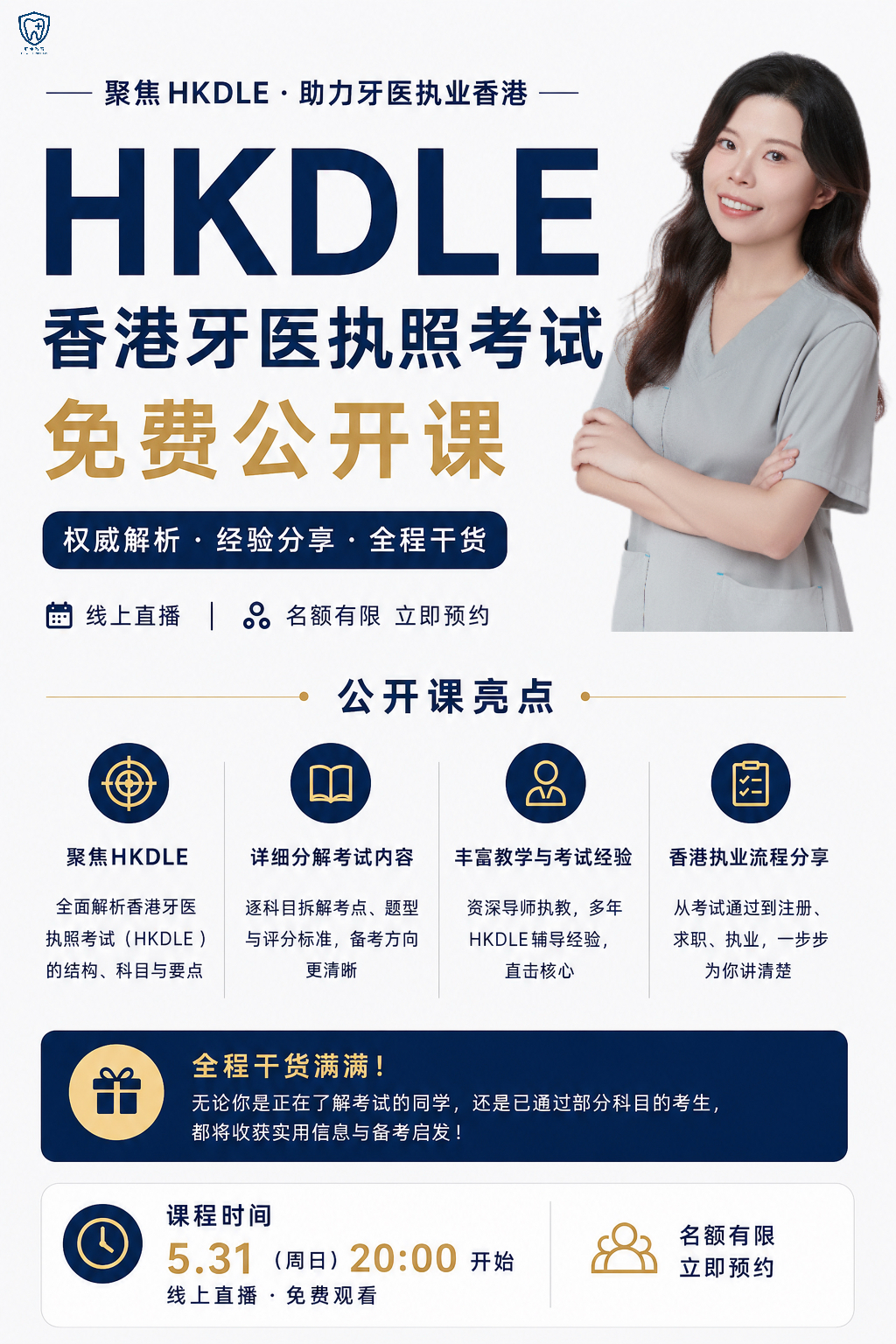
Core Value of the Trial Class:
• Eligibility Self-Check: Assist candidates in accurately evaluating whether their academic credentials, educational systems, and professional experience satisfy the official prerequisites, ensuring a correct first step.
• Comprehensive Exam Breakdown: Analyze the core difficulties and high-stakes areas across the Written Exam, Practical Exam, and Clinical Case Analysis, highlighting common error zones for mainland-trained dentists.
• Phased Preparation Strategies: Whether you are an observer evaluating industry prospects, a beginner struggling with complex paperwork, or an intermediate candidate encountering bottlenecks in practical or case analysis sections, you will receive tailored review strategies and time-management advice.
• Overview of Qualifications and Registration: Clarify the specific operational steps for independently interacting with official authorities regarding qualification applications and registration after passing the exam.
Target Audience:
• Professionals evaluating career transitions and seeking to expand into international dental tracks.
• Beginners who have just started preparing and feel overwhelmed by complex application materials.
• Intermediate candidates who have already passed certain modules but are facing bottlenecks in practical or case analysis sections.
Regardless of whether you ultimately decide to pursue a career in Hong Kong, this trial class will help you thoroughly understand the realities of the professional examination, eliminate blind informational inefficiencies, and provide a clear benchmark for your personal career planning.
How to Join:
Contact us at the backstage of Chenghei official website.