


Periodontal treatment lays the foundation of general dentistry. Correctly identifying instruments, selecting proper tools and distinguishing different models are the prerequisites for all periodontal therapies.
Mastering the official name, structure and application of every basic periodontal hand instrument greatly improves standardization in clinical practice and accuracy in licensing exams.
This guide systematically sorts out a full set of commonly-used basic periodontal hand instruments, divided into examination tools and therapeutic instruments. All Chinese names comply with the mainstream terminology adopted by dental clinics in Chinese mainland, paired with official English names and practical indications. It is suitable for long-term collection, review and exam preparation.
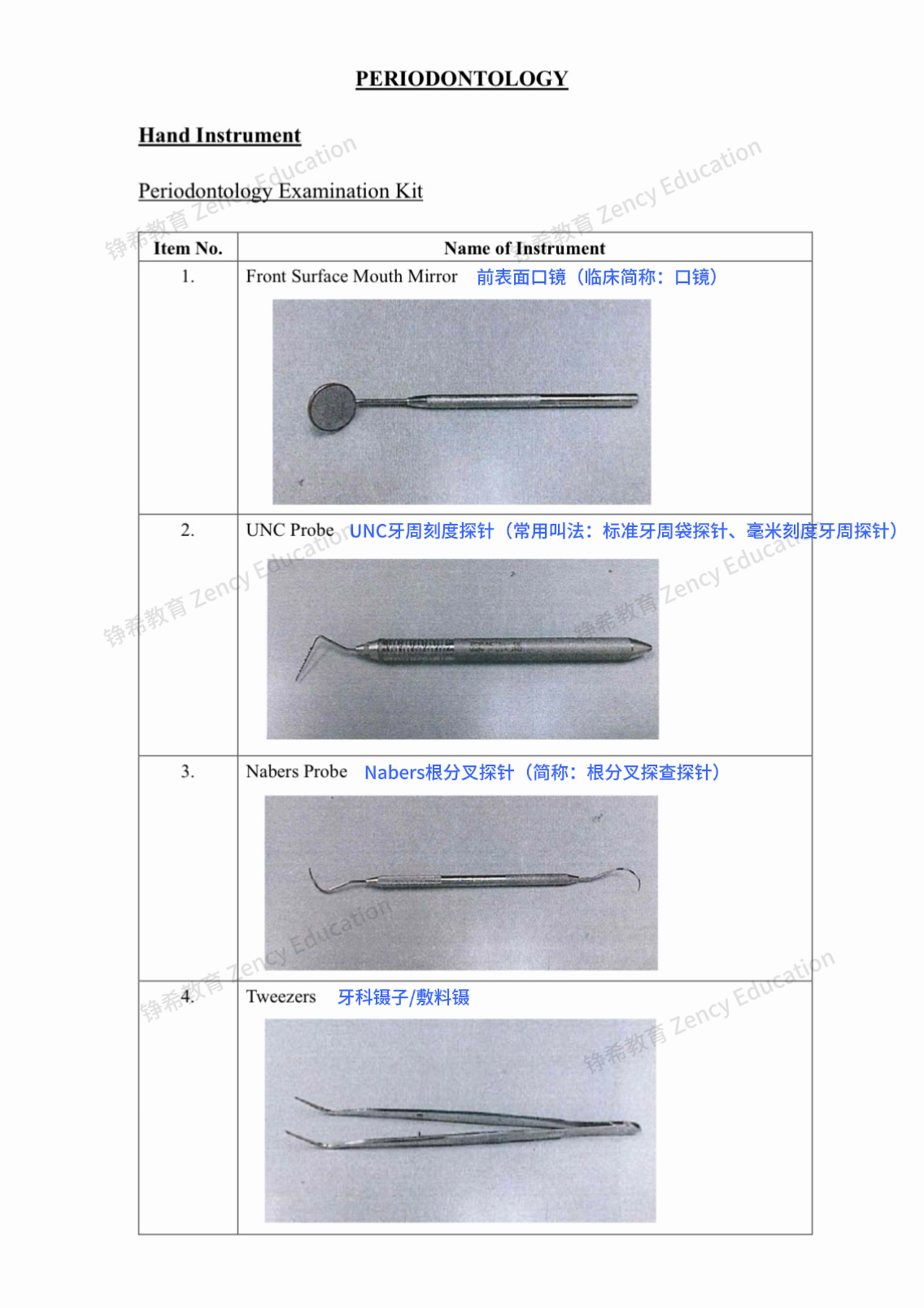
1. Basic Periodontal Examination Instruments
Periodontal examination always comes before any dental treatment. Accurate operation with matched instruments supports periodontal screening, medical record documentation and disease grading diagnosis.
1. Front Surface Mouth Mirror
It is an essential universal dental instrument. Different from rear-surface mirrors, it delivers clear imaging without double images.
Functions: retract oral soft tissues, illuminate blind operating areas, provide indirect vision for invisible tooth surfaces, assist moisture isolation during all oral checks and treatments.
2. UNC Probe
The standard tool for routine periodontal screening.
Calibrated with millimetre scales, it precisely measures sulcus depth, periodontal pocket depth and clinical attachment loss, which is mandatory for periodontal diagnosis and case grading.
3. Nabers Probe
Specialized instrument exclusive to periodontal practice.
Its forked working tip is designed to detect furcation involvement of molars and evaluate the severity of furcation lesions, indispensable for complicated periodontal cases.
4. Dental Tweezers
General auxiliary instrument, used to hold cotton balls, haemostatic materials, dressings and foreign objects for preoperative preparation and oral examination.
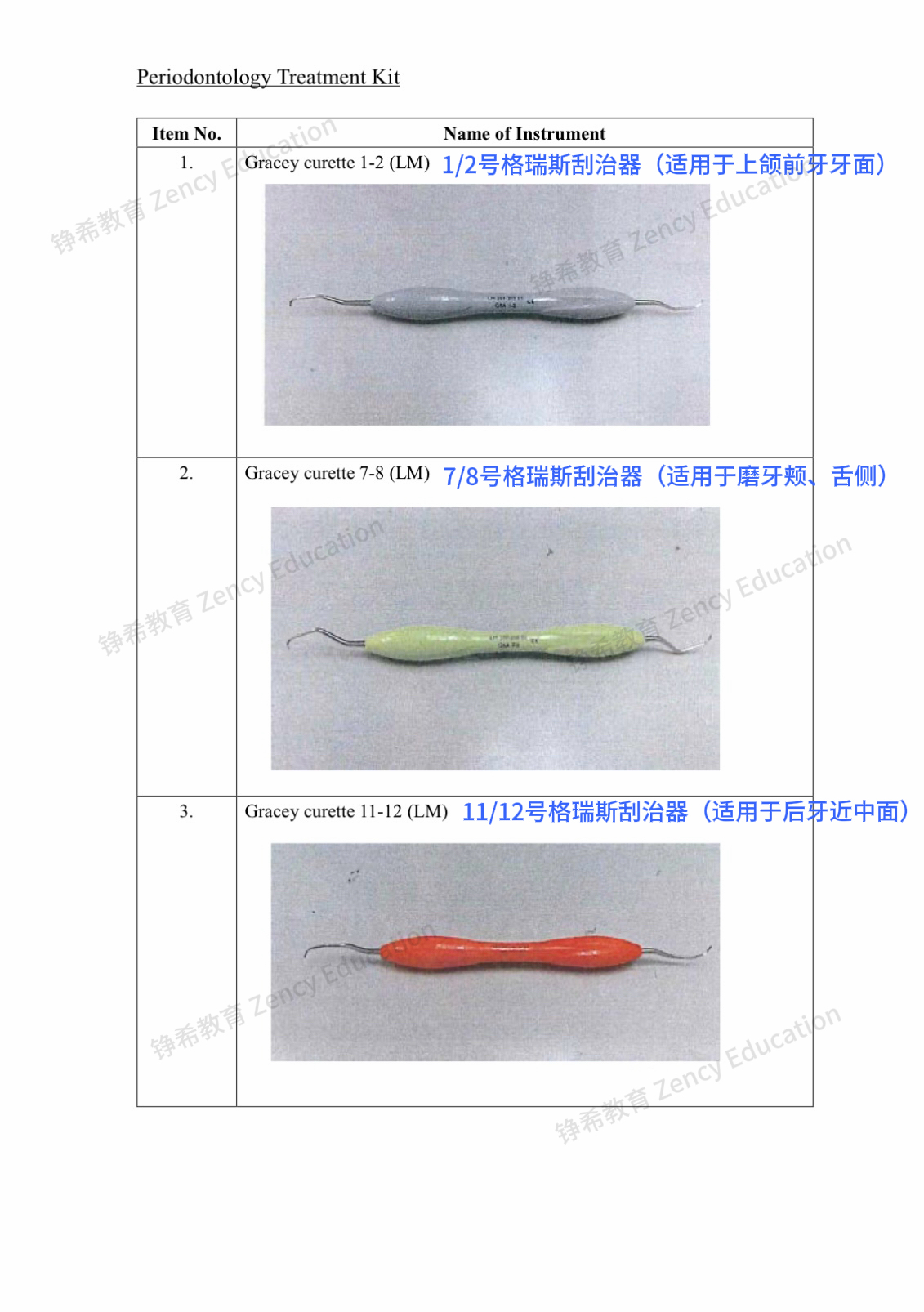
2. Core Therapeutic Periodontal Instruments (Scaling & Root Planing)
Gracey curettes and sickle scalers are the mainstream hand tools for initial periodontal therapy. Each model is designated for specific teeth and tooth surfaces, which is also a frequently-tested knowledge point for dental licensing exams.
1. Gracey Curette 1-2
Designed for anterior teeth of both maxilla and mandible.
Ideal for subgingival calculus removal, contaminated cementum elimination and root planing on labial, buccal and lingual/palatal surfaces of anterior teeth, perfectly fitting narrow operating spaces around front teeth.
2. Gracey Curette 7-8
Applied to buccal and lingual surfaces of posterior teeth (premolars & molars).
Mainly removes subgingival calculus and bacterial biofilm accumulated on broad buccolingual surfaces of posterior teeth.
3. Gracey Curette 11-12
Specially for mesial surfaces of all posterior teeth.
Its angled tip easily accesses blind interproximal mesial areas to clear hidden subgingival plaque and calculus.
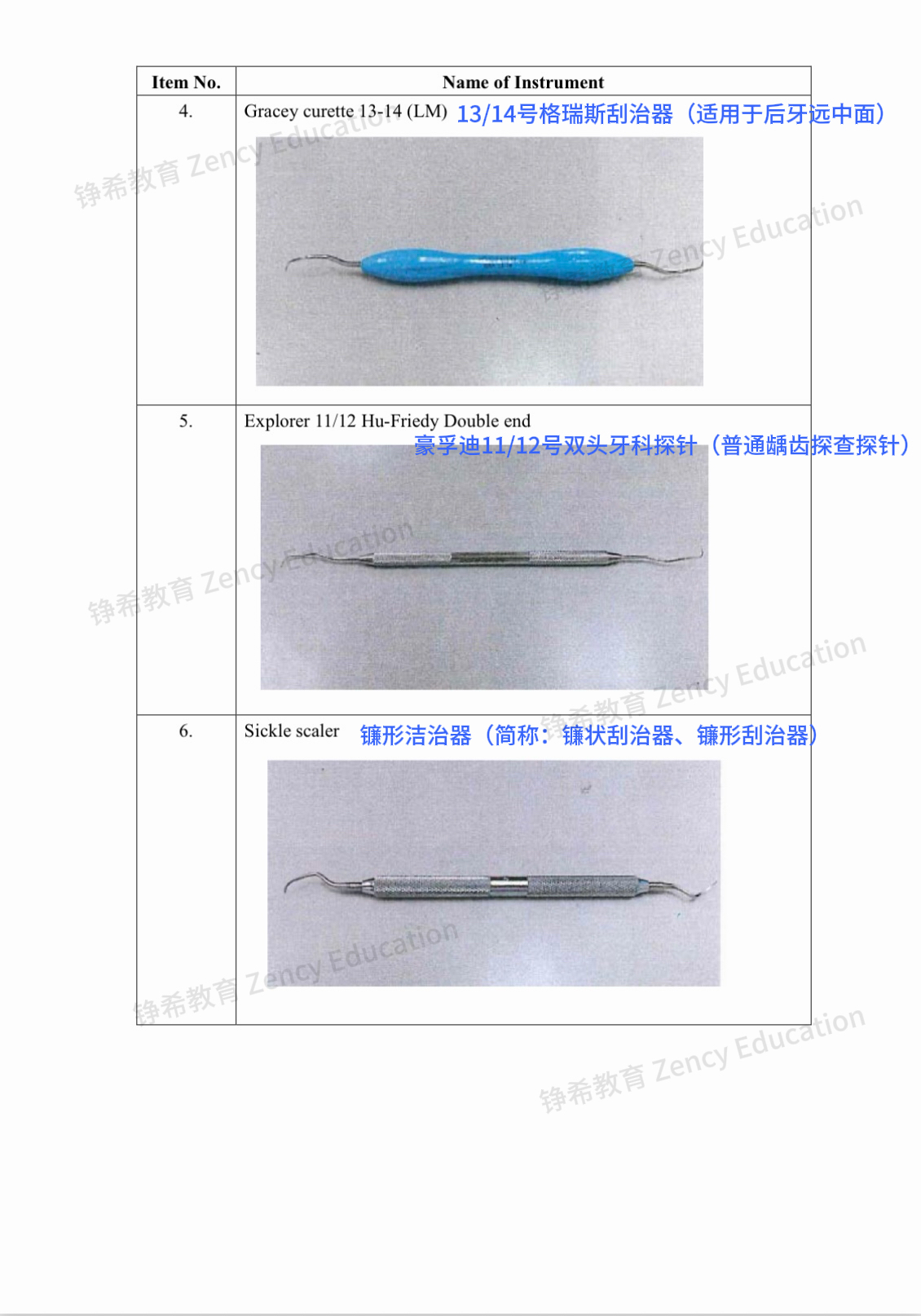
4. Gracey Curette 13-14
Customized for distal surfaces of posterior teeth.
Its unique bend fits the anatomical curve of distal tooth surfaces, solving the cleaning difficulty of hard-to-reach distal areas.
5. Explorer 11/12
Universal double-ended dental probe for general dental use.
Used to detect dental caries, cracked teeth, calculus margins and marginal integrity of restorations.
6. Sickle Scaler
Classic supragingival scaling instrument.
With sharp thin cutting edges, it efficiently removes bulky supragingival calculus, pigmentation and dental plaque on visible crown surfaces.
Key Takeaways for Learning Periodontal Instruments
1. Classification of probes
General probes detect caries and enamel defects; UNC probes measure periodontal pockets; Nabers probes check furcation lesions. These three instruments serve completely different clinical purposes.
2. Core rules for Gracey curettes
Gracey curettes are area-specific instruments. Each pair corresponds to fixed tooth positions, which is the core knowledge for standardized periodontal operation and identification questions in exams.
Target Readers
• Dental students building a solid foundation of instrument recognition
• Young dentists standardizing fundamental periodontal treatments
• Candidates preparing for dental licensing exams
• Practising dentists reviewing basic clinical skills
Final Words
Periodontal care is the cornerstone of comprehensive dentistry. Identifying and utilising instruments properly is the first step of professional periodontal treatment.
Proficiency in nomenclature, morphology and applicable scenarios of basic periodontal instruments helps standardise clinical operations and raise exam scores.
Save the illustrated instrument comparison chart for regular review to consolidate your dental expertise step by step.