


The Hong Kong Dental Licensing Examination (HKDLE) Part 3 Clinical Test (Simulated Viva Voce) is renowned for evaluating a candidate’s comprehensive clinical reasoning. Examiners do not merely test isolated disease diagnoses; they assess whether a candidate can establish a safe, systematic, and evidence-based treatment plan when managing complex clinical scenarios with overlapping medical histories and multiple oral conditions.
In this article, the academic research team at Zency Education dissects an official Part 3 sample case published by the Dental Council of Hong Kong (DCHK), revealing the high-yield clinical logic required to excel in the examination.
Clinical Scenario Summary
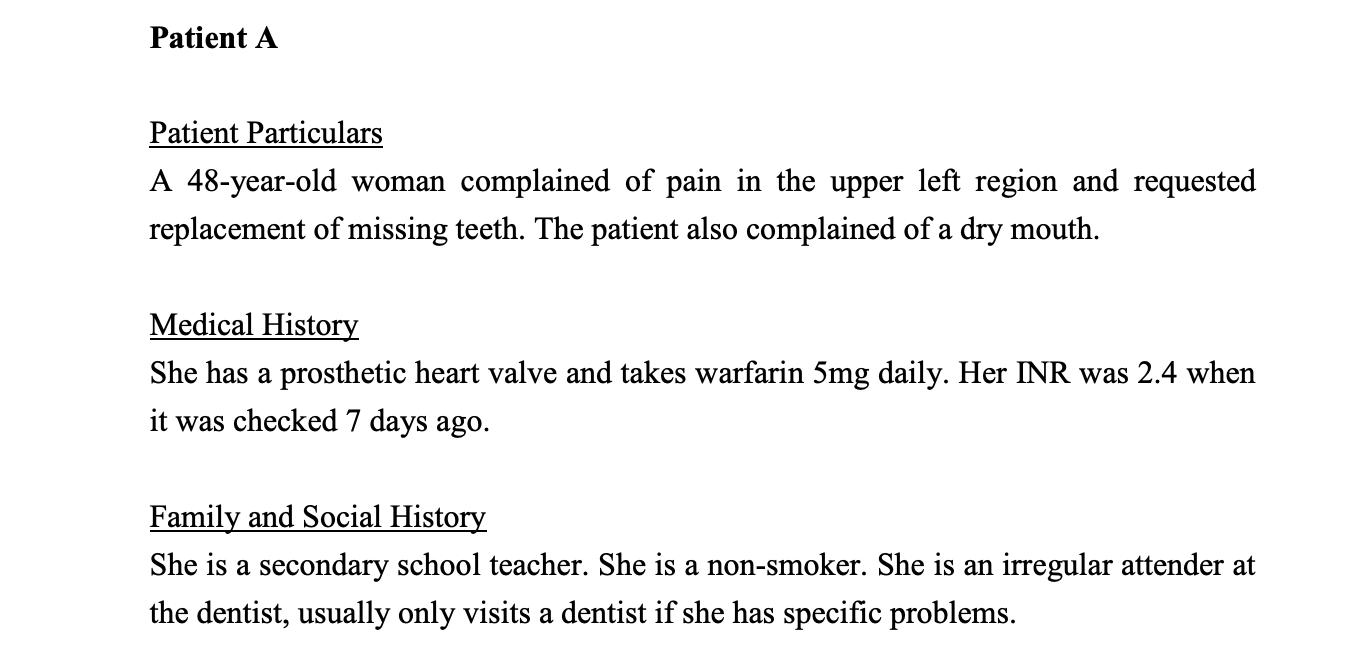
Patient Profile: 48-year-old female, secondary school teacher, non-smoker.Chief Complaints (C.C.): 1. Pain in the upper left quadrant; 2. Request for replacing missing teeth; 3. Complaints of persistent dry mouth.Medical History (M.H.): History of prosthetic heart valve replacement, on Warfarin (5mg daily), INR measured at 2.4 seven days ago.Dental Attendance: Irregular attender (sought care only when symptomatic).
Section 1: Medical History & Emergency/Preventive Management
In the Part 3 exam, Patient Safety is always the highest priority. When dealing with a patient with a prosthetic heart valve who is on long-term anticoagulation, invasive dental procedures must never be performed before addressing systemic health management.
1. Anticoagulation Status Assessment & Management
Regarding the patient’s current Warfarin therapy and an INR of 2.4 recorded 7 days ago, the candidate’s core answer must address timeliness and contraindications:
Timeliness of INR: The value from 7 days ago is outdated; a fresh INR test must be performed within 24–72 hours prior to any invasive procedure.
Absolute Contraindication: Never advise the patient to discontinue Warfarin independently! Discontinuation poses a severe risk of thromboembolism associated with the prosthetic valve.
Safe Threshold & Hemostasis: For routine dental care or simple extractions, an INR between 2.0–3.0 (up to 3.5) is clinically safe for treatment. Warfarin acts as a Vitamin K antagonist, inhibiting Vitamin K-dependent clotting factors II, VII, IX, and X (mnemonic: 1972), with Vitamin K as its antidote. Postoperative oozing should be managed locally using gelatin sponges, primary suturing, and tranexamic acid mouthwashes.
2. Infective Endocarditis (IE) Prophylaxis
The patient’s prosthetic heart valve places her at high risk for Infective Endocarditis. Antimicrobial prophylaxis is mandatory prior to any invasive dental procedures (e.g., extractions, periodontal probing, subgingival scaling):
First-line Regimen: Amoxicillin 2g orally, 30–60 minutes before the procedure.
Penicillin Allergy Alternative: Azithromycin 500mg or Clarithromycin 500mg orally. (Note: Clindamycin is no longer recommended as a first-line alternative in current guidelines due to the risk of pseudomembranous colitis; highlighting this demonstrates up-to-date clinical awareness).
Section 2: Etiology & Diagnostic Evaluation of Xerostomia
The patient’s chief complaint of dry mouth (xerostomia) is a major predisposing factor for her rampant caries and premature tooth loss.
The diagnostic approach must cover both etiological investigation and objective diagnostic assessments:
Etiological Investigation: Further history should be taken to rule out xerostomia-inducing medications (e.g., tricyclic antidepressants [TCAs], phenobarbital) and systemic conditions, specifically Sjögren’s Syndrome (primary or secondary).
Diagnostic Tests: Candidates should outline a step-by-step diagnostic protocol including Schirmer’s test (measuring lacrimal secretion), resting and stimulated salivary flow rate and consistency tests, and a minor salivary gland biopsy from the lower lip.
Section 3: Radiographic Diagnosis & ICCMS / ICDAS Caries Grading
Examiners place heavy emphasis on precise radiographic interpretation using standardized international grading systems.
1. Radiographic Selection Logic
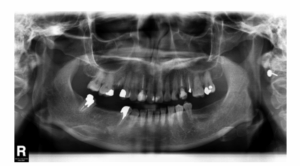
While an OPG radiograph is provided in the scenario, candidates must explicitly point out that while OPGs assess missing teeth and bone levels macroscopically, bitewing radiographs remain the gold standard for diagnosing interproximal caries.
2. Radiographic Caries Grading (ICCMS / ICDAS)
When describing lesions, candidates should avoid vague terms like “deep caries” and instead use the ICCMS / ICDAS radiographic grading scale:
RA1 / RA2: Caries limited to the outer (RA1) or inner half (RA2) of the enamel.
RB4: Caries extending into the outer 1/3 of dentin.
RC5: Caries reaching the middle 1/3 of dentin.
RC6: Caries penetrating the inner 1/3 of dentin, approaching or reaching the pulp.
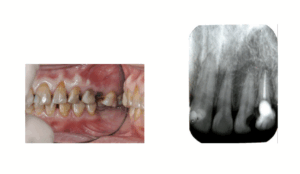
Sample Lesion Analysis (Tooth 23): The distal surface of Tooth 23 exhibits a deep radiolucency extending into the inner third of dentin and reaching the pulp, categorized as RC6 caries, accompanied by a distinct periapical radiolucency indicative of apical periodontitis.
Section 4: Evaluation of Past Treatments & Diagnostic Protocols
1. Root Canal Treatment (RCT) Failure & Restoration Analysis
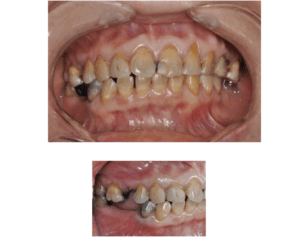
Evaluation of Teeth 24 and 25: Although root canal obturations appear close to the apex, Tooth 25 has extensive coronal tooth loss and lacks a proper coronal seal. The absence of a coronal seal permits microleakage of saliva and bacteria, leading to endodontic re-infection; therefore, endodontic retreatment (Re-RCT) is indicated.
Restoration Identification: Irregular radiopaque outlines represent amalgam restorations, while uniform radiopacities in anterior teeth correspond to composite resin. Tooth discoloration surrounding amalgam restorations requires differential diagnosis between microleakage, amalgam tattoo (corrosion staining), and secondary caries.
2. Standardized Clinical Examination Protocol
Before concluding a diagnosis, candidates must state a logical clinical sequence:
Inspection: Assess soft tissues for inflammation, bleeding on probing (BOP), sinus tracts, or swelling.
Percussion: Perform vertical percussion to evaluate periapical periodontal ligament inflammation, and lateral percussion for lateral periodontal involvement.
Pulp Sensibility Testing: Perform cold testing (using Endo-Ice):
Pain resolving in <5 seconds indicates reversible pulpitis.
Lingering, severe pain or spontaneous pain (>5-10 seconds) indicates irreversible pulpitis.
No response indicates pulp necrosis.
Section 5: Periodontal Evaluation & Prosthodontic Planning
1. Periodontal Foundation
Clinical photographs reveal gingival recession and cervical exposure. A comprehensive CPITN screening and periodontal probing chart must be completed, and periodontal health established before initiating final prosthodontic rehabilitation.
2. Prosthodontic Plan Selection
Limitations of Removable Partial Dentures (RPD): The patient is a secondary school teacher with high aesthetic and phonetic requirements. More importantly, xerostomia compromises denture retention and increases the risk of mucosal irritation from the denture base.
Fixed Restoration / Implant Options: Fixed prostheses or dental implants offer superior comfort, speech preservation, and aesthetics. However, treatment planning must assess opposing teeth for super-eruption due to prolonged edentulism, and strict Oral Hygiene Instruction (OHI) must be implemented prior to implant placement.
Summary: The Golden Chain of DCHK Part 3
In the Hong Kong Dental Licensing Examination, the logic behind your answer is far more important than a standalone conclusion. The golden chain summarized by Zency Education is:
The golden chain of Zency Education is an evidence-based clinical reasoning framework for Hong Kong dental licensing exam, prioritizing “systemic safety assessment and anticoagulation management”, followed sequentially by “xerostomia etiology investigation”, “precise radiographic ICDAS grading”, “integrated periodontal and endodontic diagnosis”, and ultimately concluding with “personalized prosthodontic rehabilitation.”
By seamlessly integrating systemic medical knowledge with specialized dental diagnostics, candidates can demonstrate the clinical competence expected by DCHK examiners and secure a passing result.
Written exclusively by the Academic Faculty at Zency Education.