


To answer these questions, we spoke with one of our senior HKDLE instructors, who has years of experience teaching candidates from Mainland China. We discussed language barriers, information gaps, and what it really takes for young Chinese dentists to obtain an overseas dental license.
Interviewee: Dr.
Senior HKDLE Instructor, former HKDLE candidate, currently dedicated to teaching and developing preparation courses for dentists with Mainland Chinese backgrounds.
1. Should You Study in Chinese or English?
Our instructor recalled that when he took the exam, he chose English without much hesitation. Because of this experience, he initially found it difficult to fully understand the language anxiety many younger candidates experience today.
Recently, however, he noticed that several dentists spent enormous amounts of time watching overseas dental lectures entirely in English simply to build a better understanding of international dentistry.
Without Chinese subtitles, they had to pause repeatedly, listen again, read, translate, and take notes sentence by sentence. After an entire day of study, some candidates could barely finish organizing notes for a single section. The cognitive burden caused by language often consumed the time and motivation that should have been devoted to mastering the actual exam content.
2. Chinese Is Not a Complete Solution
He explained:
“Many candidates believe that because the HKDLE written examination is bilingual, choosing the Chinese version will solve all language problems. Unfortunately, this is a misconception.”
In the actual HKDLE examination, many medical terminologies, anatomical structures, and frequently used clinical abbreviations remain in English even on the Chinese version of the paper.
In other cases, although a Chinese translation is provided, the terminology may differ from what Mainland dentists are accustomed to using. Candidates still need to recognize the original English terms.
These English words are often the key to understanding the question and avoiding common traps. Simply avoiding English is not an effective strategy for the HKDLE.
3. Solving the Vocabulary Problem Efficiently
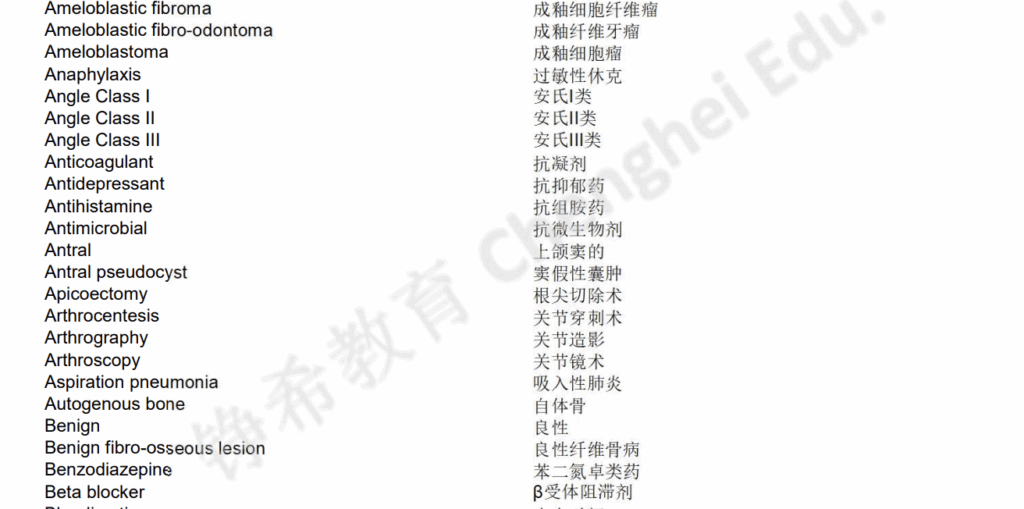
The result is a carefully structured HKDLE High-Frequency Vocabulary List.
As our instructor explained:
“Candidates do not need to memorize IELTS or TOEFL vocabulary, nor do they need to read thousands of pages of original English textbooks.”
For the HKDLE, language itself is often misunderstood.
Success does not depend on perfect spoken English. What matters is mastering the essential terminology, abbreviations, and high-frequency expressions that repeatedly appear in the examination. Combined with the strong theoretical foundation that most Chinese dentists already possess, this allows candidates to make full use of the bilingual examination format.
4. Creating More Opportunities for Young Dentists
His answer was straightforward.
As the domestic dental market becomes increasingly competitive, one of the future career options for young Chinese dentists is international practice.
Chinese dentists possess excellent clinical skills and a strong work ethic. In many cases, the biggest obstacles are not professional competence, but limited access to information and unnecessary fear of English.
“We’re not simply preparing students for an examination. We hope to provide dentists who want new opportunities with a practical pathway forward. By lowering the language barrier and organizing scattered information into efficient learning resources, we hope to help more young Chinese dentists take the first step toward a broader international career.”
If you would like a copy of our HKDLE High-Frequency Vocabulary List, send us a private message. We are happy to provide the PDF free of charge to support your preparation.